I've been exceptionally busy / lazy over the last few months. I've neglected my blogs / facebooking and twittering, keeping up with this social networking malarky is actually quite time consuming.
So now that I've caught up with my podcasts, edited my bookmarks (which had gotten out of control-actually I'm still doing this), facebooked, twittered, sorted email folders (why don't I just use search instead?), I think I can write a blog post or two.
You wait ages for a blog entry, then two come along at once. Typical!
Sunday, March 21, 2010

Saturday, February 13, 2010
What does Apple's latest iThing mean for education?

Whilst Apple are certainly not the first to enter into the tablet market, it's iPad could make a significant impact within education. The word tablet is often used to describe a mobile computer with a keyboard and a rotating screen which can fold back on itself. Mobile devices like Apple's iPad are described as a 'slates'. In fact Rich has certainly been ahead of the curve as he has been using pen based slate systems from Motion Computing for years!
So what specific advantages does the Apple iPad have to offer eduction?

Accessing iTunesU on the iPhone

Medical and Educational apps for iPhone
So, what don't I like about the Apple iPad?
I think the iPad is crying out for a camera. In fact I think it needs 2 cameras, in a front and rear facing design. The front facing 'iSight' camera could be used for Video conferencing using Skype and iChat, with the rear camera used for mapping and augmented reality. Alas the iPad has a distinct lack of cameras ;/
Lack of flash support. Although this might be seen as a severe problem now, the industry may be moving towards HTML5 and web streaming technologies that do not use flash. This could mean this is not as serious an omission as first thought. Using YouTube will not be a problem as it is available in app form, just like on the iPhone. For instance when I click on YouTube content from the Facebook app on my iPhone, the YouTube app launches and plays the video. When I have finished watching the YouTube video, the facebook app launches and takes me back to where I was. I can see flash support working in the same way on the iPad if flash was to appear as an app.
The iPad is single user. I don't like the seaming inability to log into the iPad so it can be easily shared between multiple users. I was hoping that an iSight camera would use face recognition to log each user in.
I would have preferred GPS in every model. It would be good to see the 3G enabled iPad models cheaper, and the wifi models scrapped. While the wifi models will be able to display your location using wifi access points, GPS would allow more accurate use of Google Maps.
There are a few minor negative points about the iPad, but they are far outweighed by enormous potential for the platform. With the trends in mobile and cloud use sky-rocketing, I believe the iPad can only be a success!
Gizmodo has some excellent Slate information
BBC focus magazine iRex iLiad Book Edition £449, winner of the best current ebook reader.
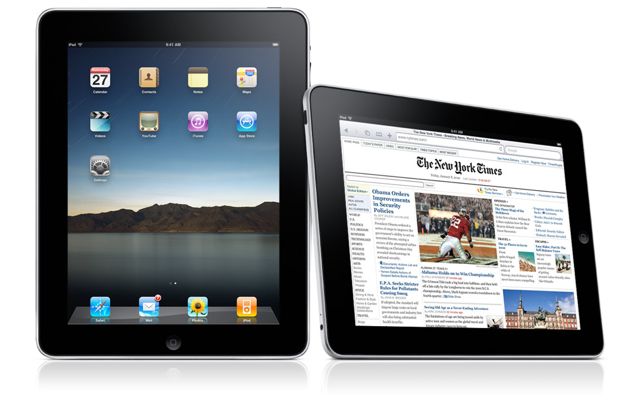
Whilst Apple are certainly not the first to enter into the tablet market, it's iPad could make a significant impact within education. The word tablet is often used to describe a mobile computer with a keyboard and a rotating screen which can fold back on itself. Mobile devices like Apple's iPad are described as a 'slates'. In fact Rich has certainly been ahead of the curve as he has been using pen based slate systems from Motion Computing for years!
So what specific advantages does the Apple iPad have to offer eduction?
- The OS does not have to be installed by the University
- It boots in 15 seconds from solid state storage
- Users can update their OS without IT department help or affecting set-up
- It is immune to virus attack
- The student would have direct access to iTunesU, which has already been embraced by many top Universities such as The Open University, Birmingham City University, The University of Edinburgh, Oxford University, Cambridge University, and many more!
- Library material could be delivered directly to the student
- Book publishers will be offering course-books as digital downloads
- Students can manage their educational digital lives, subscribing to University feeds and podcasts
- The iPad could be used to present work, and run full 'keynote' and 'powerpoint' presentations
- Like the iPod/iPhone, the iPad should provide Microsoft exchange email, calendaring and contacts services
- The student could make use of fast wifi 802.11n connections across campus
- Students could carry all of their course-books and research with them, the iPad weighs only 1.5 pounds
- With 10 hours usage and 1 month standby, it can last all day on one charge and be easily charged via USB.
- Students can make use of Wikis and Blogs and collaborate with each other
- The iPad is an iPod, web browser, feed reader, ebook reader and more it only costs $499 / £319
- There are no media players, codecs or drivers to install and maintain. It just works.
- Rich and varied educational apps are available for the iPad from the app store, especially in the field of medicine
- It is almost perfect for exploring the GeoWeb and mapping services across campus
- Computer science students can use a freely available software development kit learning to code their own applications
- Many languages are supported through an enhanced software keyboard
- It is intuitive, reliable and easy to use
Accessing iTunesU on the iPhone
Medical and Educational apps for iPhone
So, what don't I like about the Apple iPad?
I think the iPad is crying out for a camera. In fact I think it needs 2 cameras, in a front and rear facing design. The front facing 'iSight' camera could be used for Video conferencing using Skype and iChat, with the rear camera used for mapping and augmented reality. Alas the iPad has a distinct lack of cameras ;/
Lack of flash support. Although this might be seen as a severe problem now, the industry may be moving towards HTML5 and web streaming technologies that do not use flash. This could mean this is not as serious an omission as first thought. Using YouTube will not be a problem as it is available in app form, just like on the iPhone. For instance when I click on YouTube content from the Facebook app on my iPhone, the YouTube app launches and plays the video. When I have finished watching the YouTube video, the facebook app launches and takes me back to where I was. I can see flash support working in the same way on the iPad if flash was to appear as an app.
The iPad is single user. I don't like the seaming inability to log into the iPad so it can be easily shared between multiple users. I was hoping that an iSight camera would use face recognition to log each user in.
I would have preferred GPS in every model. It would be good to see the 3G enabled iPad models cheaper, and the wifi models scrapped. While the wifi models will be able to display your location using wifi access points, GPS would allow more accurate use of Google Maps.
There are a few minor negative points about the iPad, but they are far outweighed by enormous potential for the platform. With the trends in mobile and cloud use sky-rocketing, I believe the iPad can only be a success!
Gizmodo has some excellent Slate information
BBC focus magazine iRex iLiad Book Edition £449, winner of the best current ebook reader.
Saturday, December 5, 2009
Great Mac like volume control for Windows
Having a lack of drivers for those extended buttons on my Sony Vaio laptop, I discovered a fantasticly useful application for Windows. It's called simply 3RVX, it allows you to set hotkey combinations to control volume. Such quality freeware!


Sunday, October 25, 2009
Microsoft not compatible with Microsoft?
Microsoft live mail, part of Microsoft Live Essentials offers no support for getting your email, calendars and contacts from exchange 2007!
Not only am I shocked that Windows 7 comes with no email client out of the box, but it isn't even compatible with its own company's mail, calandaring and contacts solution. On my Mac it takes just a couple of clicks to set up exchange support for Apple mail, iCal and Address book all of which are available out of the box. Even Linux in its Ubuntu form comes with evolution mail supporting exchange mail, calendars and contacts.
Further more, isn't the clue in the name? Windows live essentials, i.e. essential apps, i.e. a bloody email client! So in an attempt to slim down Windows 7 which is admittedly much slimmer than Vista but nowhere near as slim as OSX or Ubuntu, Microsoft have chosen to axe essential apps resulting in a much poorer out of box experience.
I like Windows 7, it is certainly the best Windows yet with much to commend. But this just shows that the words 'joined up thinking' and 'Microsoft' cannot be used in the same sentence!
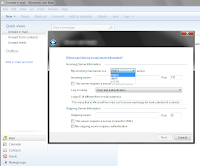
Not only am I shocked that Windows 7 comes with no email client out of the box, but it isn't even compatible with its own company's mail, calandaring and contacts solution. On my Mac it takes just a couple of clicks to set up exchange support for Apple mail, iCal and Address book all of which are available out of the box. Even Linux in its Ubuntu form comes with evolution mail supporting exchange mail, calendars and contacts.

Further more, isn't the clue in the name? Windows live essentials, i.e. essential apps, i.e. a bloody email client! So in an attempt to slim down Windows 7 which is admittedly much slimmer than Vista but nowhere near as slim as OSX or Ubuntu, Microsoft have chosen to axe essential apps resulting in a much poorer out of box experience.
I like Windows 7, it is certainly the best Windows yet with much to commend. But this just shows that the words 'joined up thinking' and 'Microsoft' cannot be used in the same sentence!

Monday, October 19, 2009
Microsoft Security Essentials
Although I have not yet thrown live viruses at Microsoft's new security essentials virus protection software, initial results have been very good indeed. Microsoft Security Essentials takes only a small amount of memory whilst running, system and file scanning is fast, real-time protection uses minimal system resources, and it has a very efficient virus definitions update process.
I have replaced AVG (free) with Microsoft security essentials and have noticed a big improvement in the speed and responsiveness of the system. So much so, that my aging Sony Vaio with 1gb of RAM has suddenly become a very usable system running Windows 7 and Microsoft security essentials.
Now to set up a walled garden virtual machine environment, and throw some viruses at it to see if anything sticks. If the results are good I can see little point PC sellers pushing the majority of customers to buy 3rd party security suites which generally cripple the computers they run on. Although I doubt that will stop them trying.
I have replaced AVG (free) with Microsoft security essentials and have noticed a big improvement in the speed and responsiveness of the system. So much so, that my aging Sony Vaio with 1gb of RAM has suddenly become a very usable system running Windows 7 and Microsoft security essentials.
Now to set up a walled garden virtual machine environment, and throw some viruses at it to see if anything sticks. If the results are good I can see little point PC sellers pushing the majority of customers to buy 3rd party security suites which generally cripple the computers they run on. Although I doubt that will stop them trying.
Tuesday, July 7, 2009
Laptop and Desktop doomed?
As the popularity of mobile computing dramatically increases in the phone space, there is the distinct possibility that smart phones become the next main computing platform. You would have the ability to slot your mobile into a desktop docking station (possibly inside the display), similarly you would be able to slot your mobile into a laptop docking station. This is not as crazy as it first appears, ten years ago desktop computers were running at a speed of 200Mhz, today the iPhone 3Gs runs at 600Mhz easily able to run complex software. Within 5 years the mobile phone will reach processing speeds into the multi Ghz range allowing complex desktop class software to run.
Modern smart phones already run some desktop class software and OS's (OSX iPhone, Windows mobile, Android), today I could do most of my job just using my mobile. How long will it be before the only computer I need is my mobile phone?
Modern smart phones already run some desktop class software and OS's (OSX iPhone, Windows mobile, Android), today I could do most of my job just using my mobile. How long will it be before the only computer I need is my mobile phone?
Monday, June 15, 2009
SAASY Google
Software As A Service combines cloud back end services with either web based applications, or synced desktop applications..
What does this mean? It means that Microsoft should be looking over their shoulder in case another company decides it would like to get into the enterprise market. Google has launched their Google Apps SAAS offering which can act as a full exchange solution, with the ability to even migrate an existing exchange environment. Users can even use outlook with all the facilities of Microsoft Exchange without needing the server, or the air conditioned room the server lives in, or the backup infrastructure, or indeed the staff of computer experts to run it all.
It only requires an outlook plugin to work, which unfortunately does not work directly on the Mac. However the Mac can utilise sync tools to talk to Google mail/calendar/addressbook. The iPhone is able to sync with Google mail/calendaring/addressbook directly ironically using Google's licenced Microsoft Exchange solution. This allows Macs and PC's, plus many makes of mobile to use the same exchange like services millions of pounds cheaper than the Microsoft solution.
This is cloud computing at work. Microsoft still has the advantage of an excellent back end solution for PIM functions, many systems including the iPhone and Evolution Mail for Linux can directly sync with Microsoft exchange using a simple direct connection (unfortunately Evolution is not yet compatible with exchange 2007).
The complexity of running your own exchange environment is taken away by using Microsoft's cloud services. I think that Microsoft will move more and more into cloud backend services, and play less of a role in the front end of computer users lives in the future. However, Google has cloud services that work across a larger range of computer platforms and at a much cheaper price than Microsoft's cloud services.
Following the trend through to it's ultimate conclusion, it's clear that the traditional server room will cease to exist, being replaced by just a few massive data centres running hosted cloud services.
What does this mean? It means that Microsoft should be looking over their shoulder in case another company decides it would like to get into the enterprise market. Google has launched their Google Apps SAAS offering which can act as a full exchange solution, with the ability to even migrate an existing exchange environment. Users can even use outlook with all the facilities of Microsoft Exchange without needing the server, or the air conditioned room the server lives in, or the backup infrastructure, or indeed the staff of computer experts to run it all.
It only requires an outlook plugin to work, which unfortunately does not work directly on the Mac. However the Mac can utilise sync tools to talk to Google mail/calendar/addressbook. The iPhone is able to sync with Google mail/calendaring/addressbook directly ironically using Google's licenced Microsoft Exchange solution. This allows Macs and PC's, plus many makes of mobile to use the same exchange like services millions of pounds cheaper than the Microsoft solution.
This is cloud computing at work. Microsoft still has the advantage of an excellent back end solution for PIM functions, many systems including the iPhone and Evolution Mail for Linux can directly sync with Microsoft exchange using a simple direct connection (unfortunately Evolution is not yet compatible with exchange 2007).
The complexity of running your own exchange environment is taken away by using Microsoft's cloud services. I think that Microsoft will move more and more into cloud backend services, and play less of a role in the front end of computer users lives in the future. However, Google has cloud services that work across a larger range of computer platforms and at a much cheaper price than Microsoft's cloud services.
Following the trend through to it's ultimate conclusion, it's clear that the traditional server room will cease to exist, being replaced by just a few massive data centres running hosted cloud services.
Subscribe to:
Posts (Atom)